
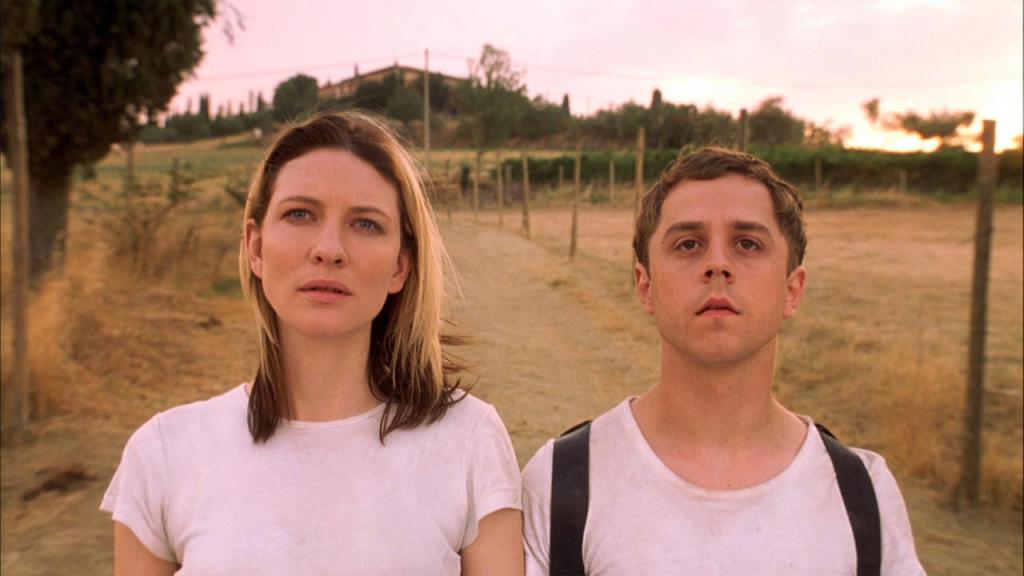
Tom Tykwer · Cate Blanchett, Giovanni Ribisi, Remo Girone · 1h 37m · 2002
Directed by Tom Tykwer, “Heaven” was presented to the cinema world as the first part of the Heaven-Hell-Purgatory trilogy, written by Krzysztof Kieslowski but not brought to the screen by him due to his passing. This film has managed to leave an unforgettable impact on its audience with both its visual and emotional depth. With Tykwer’s unique interpretation added to Kieslowski’s screenplay, the work that appears before the audience is indeed an example of poetic cinema.
The film opens with a prologue sequence where young Italian police officer Filippo (Giovanni Ribisi) learns to fly a helicopter using a flight simulator. When Filippo causes a crash by elevating the virtual helicopter too rapidly, his instructor tells him, “In a real helicopter, you can’t keep going up and up,” leading Filippo to ask, “How high can I fly?” This scene acts as a harbinger for the film’s ending and its cyclical nature. Subsequently, we see Philippa (Cate Blanchett) preparing to place a bomb in the downtown office of a high-profile businessman. The garbage bin where she places the bomb is emptied by a cleaner just after Philippa leaves, and the bomb later explodes in an elevator, killing four people. After this incident, the lives of Filippo and Philippa, whose paths cross, will never be the same, and they will set off towards a completely different destination together.
The film captivates independently of its story with Italy’s breathtaking landscapes presented in an artistic manner and a soundtrack adorned with piano melodies. The performances of Cate Blanchett and Giovanni Ribisi in the leading roles masterfully convey the complex emotions of their characters and their extraordinary love story. Close-up shots highlight Blanchett’s characteristic beauty and Ribisi’s character’s pure love, drawing the audience into the heart of the story.
“Heaven” presents an impressive story that progresses without falling into clichés, depicting how love can lead to purification and salvation in the face of tragedy and fate. The story of Philippa and Filippo takes the audience on a deep emotional journey; we witness their transcendence from worldly bonds to reach heaven, presented almost as a ritual of love. Director Tom Tykwer enriches Kieslowski’s screenplay with his unique touches, offering the audience an unforgettable visual and emotional experience.
The narrative of the film prefers to advance the story through the power of visuals rather than lengthy dialogues. This approach allows it to address themes such as crime and morality more effectively. The film tells the story of Philippa’s journey of revenge and her unexpected love affair with Filippo, using the most powerful elements of cinema.
Director Tom Tykwer enriches Kieslowski’s screenplay with his unique touches, offering the audience an unforgettable visual and emotional experience.
Cate Blanchett, with her performance in the film, captivatingly conveys Philippa’s internal conflict with exquisite sensitivity. The complex emotions of a woman who finds herself in the midst of an unexpected tragedy while pursuing revenge, as masterfully depicted by Blanchett, emotionally shakes the audience. The character’s journey of deep remorse and purification becomes unforgettable through Blanchett’s rich emotional expression.
Giovanni Ribisi, on the other hand, becomes a symbol of pure and unconditional love with his character, Filippo. His character’s unexpected and profound devotion to Philippa, who is confronting tragedy, touches the audience’s heart thanks to Ribisi’s nuanced and sensitive performance. The performances of two talented actors like Blanchett and Ribisi stand out as elements that make the film deeply impressive.
Inheriting Kieslowski’s cinematic legacy, “Heaven” offers an impactful storytelling that pulls the audience into emotions they cannot quite name. The film delicately handles the complexity of the human spirit, the whims of fate, and the purifying power of love with an elegant artistic touch.
Inheriting Kieslowski’s cinematic legacy, “Heaven” offers an impactful storytelling that pulls the audience into emotions they cannot quite name. The film delicately handles the complexity of the human spirit, the whims of fate, and the purifying power of love with an elegant artistic touch. Its conclusion provides the audience with a metaphorical interpretation of heaven, encouraging deep reflection and prolonged thought on the film.
“Heaven” is a film that leaves a lasting impression on the audience’s memory and deeply affects its viewers, offering a visual and emotional feast with a love story that transcends time and space. It stands as a testament to the cinematic artistry of Kieslowski and Tykwer, showcasing their ability to weave compelling narratives that resonate on a profound level.
 Auteur Avenue