
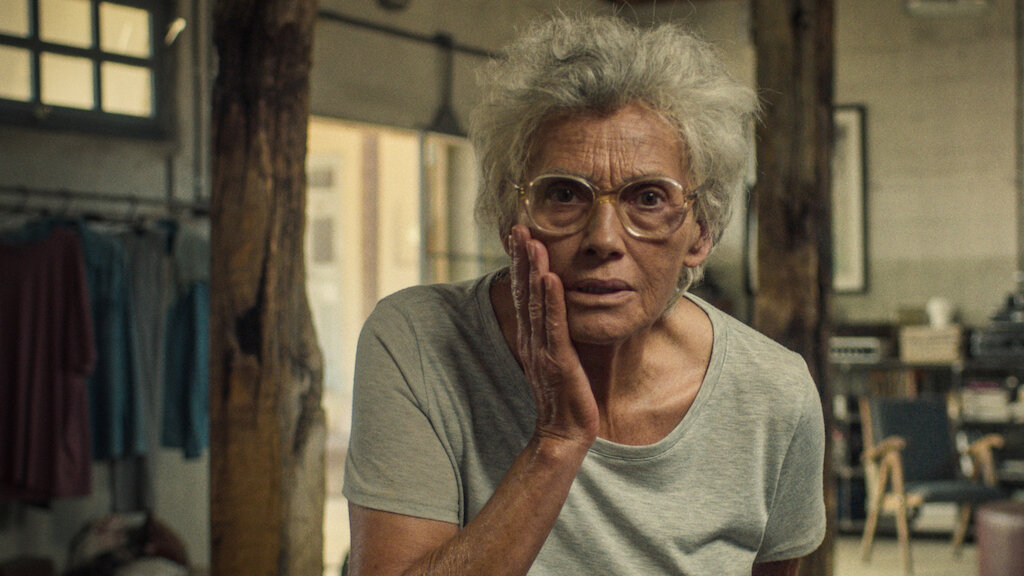
Berkun Oya · Nur Sürer, Okan Yalabık, Ayça Bingöl, Yılmaz Erdoğan · PG-16 · 2h 31m · 2022
“Gorgeous”, a feature-length drama film written and directed by Berkun Oya for Netflix, premiered in 2022 following his highly acclaimed series “Ethos”.
As for the plot of the movie, set in the 1980s in Central Anatolia, a family decides to migrate to the city after suffering a painful loss, leaving the place they had lived in for years. Thirty years later, when they return to their farmhouse bearing the marks of the past, suppressed emotions and secrets come to light, reopening old wounds. The family members, unable to sever ties with their past, are now forced to confront truths that have been concealed for years.
It is possible to say that the film takes place across three main time periods: the 1980s, the 2010s, and the pandemic period starting in 2020. Initially, we observe a segment of the family’s life in the 1980s. Bekir (Yılmaz Erdoğan) and Havva (Funda Eryiğit and Nur Sürer) have three children named Saliha, Kadir, and Yusuf. Bekir is a stern father figure, likely treating his wife and children in the manner he learned from his own father. While the television holds a significant place in the family’s life, the director also conveys the socio-political and cultural atmosphere of the 1980s through the television.
The second part of the film focuses on the adulthood of the characters we watched as children in the first part. The middle sibling, Kadir (Okan Yalabık), struggles to erase the marks of psychological violence his father inflicted on him during his childhood. He has become a director and, perhaps as a method to confront his trauma, is making an autobiographical film. His sister Saliha (Ayça Bingöl) is taking care of their mother, Havva, and his niece Naz (Şevval Balkan) is filming behind the scenes. Kadir directs his mother in a scene reminiscent of one that occurred in the past and was also featured in the first part of the film.
In the third part of the film, as a necessity of isolation following the pandemic, the siblings reunite in the house where their childhood took place, depicted in the first part, and which served as a film set in the second part. It is during this segment that unopened books begin to be opened, and the characters start to confront their pasts. This confrontation with their history allows for a deeper exploration of their relationships and unresolved issues, leading to a climactic resolution of their individual and collective journeys.
Berkun Oya continues his unique cinematic language in “Gorgeous”, as established in “Ethos”. At this point, it can be well said that there is a successful collaboration again with cinematographer Yağız Yavru, with whom he worked on the series. The camera language, which mostly positions characters in the center of the frame, and the use of long takes enhance the viewing pleasure.
In the film, there are instances of camera work that evoke the cinema of Nuri Bilge Ceylan at times, and at other times the American paranoia cinema of the 70s, with the use of zoom-ins and zoom-outs. The connection Kadir establishes with the camera his father had brought from Germany, his attempt to fill the gap in his relationship with his father through it and becoming a director, in a way the “film within a film” scenes, the moment Havva appears in a single shot at the window from the past to the present, the unresolved issues between Cemil and Saliha that linger in the minds of those “stone-like” characters, the “behind the scenes” actually revealing the aftermath of an event that occurred in the past, are all key indicators of Berkun Oya’s ability to create a unique cinematic language. It can also be said that the director has a knack for integrating elements of popular culture into his scripts in both his series and films. References to the TRT of the 1980s, career introduction videos, Bergen, and Özay Gönlüm can be cited as examples of this.
Berkun Oya continues his unique cinematic language in “Gorgeous”, as established in “Ethos”..
It can be said that the family’s home holds significant importance in the film. The editing style, which shows the house in its past states while momentarily transitioning to the present, effectively sets hooks for the film’s upcoming scenes, essentially creating flash-forwards throughout the narrative. Here, the editor Ali Aga, who also worked on the editing of “Ethos” and continued his collaboration with Berkun Oya in this project, undoubtedly plays a major role. This approach adds a layer of depth and complexity to the storytelling, seamlessly connecting the past and present.
Finally, as seen in “Ethos”, Berkun Oya delivers an unquestionably superior performance in casting and directing actors. Almost all the actors deserve praise. Yılmaz Erdoğan succeeds in making Bekir, a father figure who could appear purely evil, real with his nuanced acting. Funda Eryiğit and Nur Sürer, portraying Havva in her youth and old age respectively, complement each other very well in every sense. Okan Yalabık as Kadir, Ayça Bingöl as Saliha, and Fatih Artman as Yusuf, unveil the dramatic conflicts and relationships among the siblings with their strong acting performances. Olgun Şimşek delivers a fantastic performance as Cemil. Similarly, Cağla Naz Kargı and Efe Culfe, who portray the childhood versions of Saliha and Cemil, not only resemble their adult counterparts but also play their roles with remarkable consistency.
“Gorgeous” explores the relationships between husband and wife, mother and child, father and child, siblings, and uncle and niece across a certain time period, presenting them in all their simplicity, while treating time not as a healing force but rather as a destructive factor.
“Gorgeous” weaves a multi-layered story centered around the theme of memory, touching upon broader psychological contexts. Particularly, by observing the foundations laid in the first part of the film and how they develop and evolve in the second and third parts, we witness the transformations of the characters and the effects of events on them.
“Gorgeous” explores the relationships between husband and wife, mother and child, father and child, siblings, and uncle and niece across a certain time period, presenting them in all their simplicity, while treating time not as a healing force but rather as a destructive factor. The film succeeds in narrating experienced traumas without resorting to agitation.
 Auteur Avenue