
Nuri Bilge Ceylan · Deniz Celiloğlu, Merve Dizdar, Musab Ekici · R · 3h 17m · 2023
Note: This article contains spoilers about the film.
“About Dry Grasses,” which premiered at the 71st Cannes Film Festival in 2018, marks Nuri Bilge Ceylan‘s return to the big screen five years after “The Wild Pear Tree.” With a duration of 197 minutes, making it the director’s longest film, “About Dry Grasses” garnered the “Best Actress” award for Merve Dizdar at the 76th Cannes Film Festival.
The film centers on Samet (Deniz Celiloğlu), an art teacher serving his mandatory duty in a remote town in Erzurum. Samet’s life and emotional world will experience some fractures through Nuray (Merve Dizdar), a teacher like himself who he has just met and who works at another school in the district, and his student Sevim (Ece Bağcı).
Director Nuri Bilge Ceylan, in a press conference following the film’s premiere at the Cannes Film Festival, had stated: “The consolation that happiness lies elsewhere is true for many of us. That is, if we are dissatisfied with our lives, the comfort that we could be happy somewhere else feels good to us.” Stemming from this very point, Samet, in his fourth year of mandatory service, dreams of finishing his duty and returning to Istanbul as soon as possible.
Like the narrative in Nuri Bilge Ceylan’s “The Wild Pear Tree,” which progresses through the character Sinan’s interactions with people in his life and their dialogues, “About Dry Grasses” also delves into the emotional world of the character Samet through his dialogues and conflicts with Kenan (Musab Ekici), his colleague and roommate at the same school, Nuray, an English teacher at another school, and Sevim (Ece Bağcı), a student with whom he shares a distinctly different relationship. Samet can be interpreted as a subsequent version of Sinan from “The Wild Pear Tree,” who has completed his teaching degree and military service and is now posted in the east, and a preceding version of Mahmut from “Distant,” who went to Istanbul to realize his ideals but failed to do so, considering the director’s cinematic universe.
Samet, now weary and striving to pass the remaining time of his mandatory service, buys a gift for his student Sevim, who stands out with her vibrant energy and hopeful disposition. His constant attention to Sevim in class raises other students’ suspicions, leading to his irritation when they voice their concerns. A routine search in the classroom reveals a love letter in Sevim’s bag. We do not know to whom Sevim wrote this letter. Samet somehow obtains and reads it, thereby violating the privacy of her personal life. Even though Sevim knows Samet has read her letter, he denies it and tells her to throw it away, suggesting such things are normal and not to be upset. Thus, a dramatic break occurred between Samet and Sevim that Samet could not have foreseen.
After a short while, Kenan and Samet learnt that they have been complained due to “inappropriate interactions” with students. They vehemently deny such accusations and set out to discover who made them. After learning of the incident, Samet, influenced by the noise in his class, scolds and humiliates the students. This scene, where the director shows Samet’s face in close-up for the first time, marks a turning point in the film and for Samet’s character, as he begins to externalize his inner darkness.
In the context of Nuri Bilge Ceylan’s filmography, “About Dry Grasses” can be seen as a blend of his early cinema, which focused heavily on imagery and visuals, and his later works starting from “Once Upon a Time in Anatolia,” where dialogues become more prominent.
Meanwhile, Samet meets Nuray, a teacher at another school, through a friend in the district. Initially, Samet shows no desire for Nuray and even shows her photo to Kenan, claiming he is not interested as he will leave once his mandatory service ends. He even offers to introduce Kenan to Nuray, and does so. When Nuray begins to look at Kenan with a different perspective, saying she finds meaning in his facial expressions, and Kenan reciprocates her interest, Samet’s jealous and envious glances reveal a tension that will continue throughout the film in the Samet-Nuray-Kenan triangle. The desired starts to be desired. Samet’s jealousy escalates upon seeing Nuray and Kenan together in the town. Although Nuray invites both Samet and Kenan to dinner, Samet does not convey this invitation to Kenan and lies to Nuray about why he can’t come.
The film’s most dialogue-heavy and perhaps the peak of character conflict starts right here. After dinner, they start a conversation with the aim of getting to know each other better, but this conversation gradually evolves into a sociopolitical debate. Samet, an art teacher, admits he has stopped painting due to laziness and now only takes photographs. In contrast, Nuray, despite being an English teacher, creates what she modestly calls amateur but are actually masterful paintings. The director starkly contrasts these two characters here. Samet, influenced by his mandatory service and surroundings, has even ceased to dream. When a student in his class suggests drawing the sea, he retorts, “Have you ever seen the sea? How will you draw it?”, revealing his constricted imagination. Nuray, on the other hand, represents the opposite spectrum. As the dialogue between Samet and Nuray intensifies, so does the scene’s tempo and tension. Nuray accuses Samet of inaction and passivity, while Samet questions what contribution or benefit Nuray actually brings. Nuray is a character committed to organized struggle, fiercely loyal to her ideology, and has lost a leg in a bombing attack for her cause. In contrast, Samet is profoundly individualistic and independent, admitting he has never felt the need to define himself ideologically. He claims to be a proponent of freedom but cannot articulate what freedom truly means to him. This scene can be seen as another powerful addition to the director’s filmography of intense dialogue-driven scenes, akin to the Prosecutor Nusret-Doctor Cemal scene in “Once Upon a Time in Anatolia,” the Aydın-Necla and Aydın-Nihal scenes in “Winter Sleep,” and the Sinan-Author Süleyman scene in “The Wild Pear Tree.”
The physical education teacher at the school, Tolga (Erdem Şenocak), informs Samet and Kenan that one of the students who complained about them is Sevim. Learning from the principal about another complaint regarding his demeaning behavior towards students, Samet becomes furious and expels Sevim from the class as a punishment. The very person who, at the beginning of the film, seemed to bring a smile to his face and make him feel alive, Sevim, has now become perhaps the person he detests the most. Throughout this entire ordeal, Samet never introspects or criticizes himself, constantly blaming others. He forgets that Sevim is just a child and is swept away to a completely different place emotionally.
Especially in the scene where Samet and Nuray argue after the meal, witnessing how Celiloğlu and Dizdar elevate each other’s acting is a completely different experience.
In the context of Nuri Bilge Ceylan‘s filmography, “About Dry Grasses” can be seen as a blend of his early cinema, which focused heavily on imagery and visuals, and his later works starting from “Once Upon a Time in Anatolia,” where dialogues become more prominent. Regarding its characters, Samet embodies traits from Mahmut in “Distant,” İsa in “Climates,” Doctor Cemal in “Once Upon a Time in Anatolia,” Aydın in “Winter Sleep,” and Sinan in “The Wild Pear Tree.” However, he can also be considered as the most malevolent and dark character in Ceylan’s cinema. The film reveals his malevolence and darkness through dramatic clashes with other characters. Particularly, Nuray and Sevim act as mirrors to Samet, who has become the person he feared. Through his argument with Nuray, we learn about his views on life, belief, ideology, and sense of belonging. His relationship with Sevim shows how far he can deviate. Nuray is a unique character in Ceylan’s cinema, deeply written and integral to the film’s fabric. Sevim stands out with her cheerfulness and strong grip on life, speaking Istanbul Turkish as if she is an imaginary character placed by Samet to counteract the dullness of the place. She is, in a way, the only person Samet seems to connect with, despite his claim of not feeling a sense of belonging or attachment to anyone or anything. These characters are richly developed, each with their own life journey. “About Dry Grasses” has the richness and complexity where different films could be woven around each character like Nuray, Sevim, or Kenan, showcasing their individual stories as the central narrative.
The director Nuri Bilge Ceylan, in “About Dry Grasses,” evidently does not shy away from experimenting with new elements, marking a departure from his previous films in terms of form and style. For instance, we see photographs taken by Samet, who is an art teacher but has possibly stopped painting due to a loss of imagination. Some photos are shown as static images, while others capture the subjects in the act of posing, adding a dynamic quality. These photographs, viewed through Samet’s lens at various moments in the film, are actually taken by Nuri Bilge Ceylan himself and co-screenwriter Ebru Ceylan. Following the film’s most dialogue-intensive scene, where Samet and Nuray argue at the dinner table, there’s a pivotal moment when Samet opens a door and steps from the house into a film set. This scene is a significant risk for the director, offering an unexpected and intriguing twist. By employing a Brechtian alienation effect and breaking the fourth wall, Ceylan disrupts the audience’s identification with Samet, especially after exposing his inner world and darkness. Furthermore, in some scenes, the camera moves sharply from one character to another, a technique reminiscent of recent trends in Damien Chazelle‘s cinema. These brisk pan movements indicate the director’s willingness to embrace more contemporary cinematic techniques, adding to the film’s unique stylistic signature.
It’s widely recognized that Nuri Bilge Ceylan places great importance on actor direction and exhibits meticulousness in this regard. The casting choices and performances in “About Dry Grasses” are exceptionally noteworthy. Deniz Celiloğlu brings to life Samet, the darkest character in Ceylan’s cinematic universe, with profound realism, delivering an award-worthy performance. Merve Dizdar, portraying Nuray, one of the most intricately written female characters in Ceylan’s filmography, justifies her ‘Best Actress’ award from the Cannes Film Festival with a compelling acting display. Especially in the scene where Samet and Nuray argue after the meal, witnessing how Celiloğlu and Dizdar elevate each other’s acting is a completely different experience. Musab Ekici portrays Kenan with a natural ease, while Ece Bağcı, in the role of Sevim, shines in every scene she’s in, proving herself to be a major discovery. While Yüksel Aksu, whom we know primarily for his directorship, delivers quite a good acting performance in the role of Veterinary Vahit, Erdem Şenocak, who has come to the fore especially in films that we can call director’s cinema recently, has done his part as always.
“About Dry Grasses” is a film that contains traces of all Nuri Bilge Ceylan’s films and their main characters, yet it also distinguishes itself from them in many ways. The director is particularly unafraid to try new things in terms of form, and it is a film that commands undivided attention with its strong visuals, performances, and dialogues.
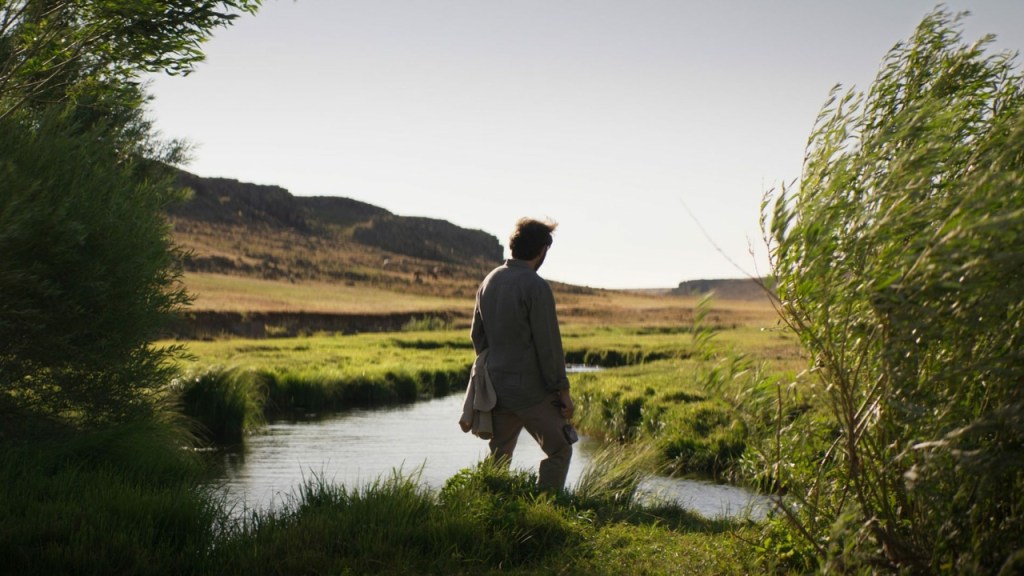
“About Dry Grasses” marks a significant departure for director Nuri Bilge Ceylan, as it’s his first film after a long period working without his regular cinematographer, Gökhan Tiryaki. Instead, the cinematography is handled by the duo of Cevahir Şahin and Kürşat Üresin, who demonstrate remarkable synergy with Ceylan’s vision. The film’s visual language is distinguished by its varied portrayal of characters, sometimes directly and other times through mirrors. It features snowy winter scenes from the opening to the final act, culminating in scenes dominated by the “dry grasses” that give the film its name. These scenes echo the aesthetic of Caspar David Friedrich, one of the important representatives of German Romanticism, particularly reminiscent of his oil painting “Wanderer above the Sea of Fog” in the way Samet is portrayed. The focus on characters in single-shot scenes, and the evocative imagery, such as the scene where Kenan and Samet drive Nuray home at night with the soft snowflakes gently reflecting on the car, all showcase the cinematographers’ ability to align their work with Ceylan’s renowned style. These elements contribute to the film’s rich visual tapestry, enhancing its emotional and thematic depth.
The film concludes with a distinct and thought-provoking choice: the final sequence where Samet, having completed his mandatory service and moving on to teach elsewhere, writes a letter to Sevim and narrates it. This ending opens up a new perspective, leaving the audience with these lingering questions: Will Samet find the peace and happiness he seeks in the new place he goes to? Or, due to the darkness within him, will he somehow find a way to be restless and unhappy?
“About Dry Grasses” is a film that contains traces of all Nuri Bilge Ceylan‘s films and their main characters, yet it also distinguishes itself from them in many ways. The director is particularly unafraid to try new things in terms of form, and it is a film that commands undivided attention with its strong visuals, performances, and dialogues. It is a film that underlines the state of being ‘tired of hoping’ while vividly and strikingly laying bare the dark sides and contradictions experienced by humans. Perhaps, as Nuray suggests, “everything beautiful in the world gets trapped in the webs we weave before it can even reach us,” encapsulating the film’s exploration of the human condition and the often self-imposed barriers to our happiness and fulfillment.
 Auteur Avenue