
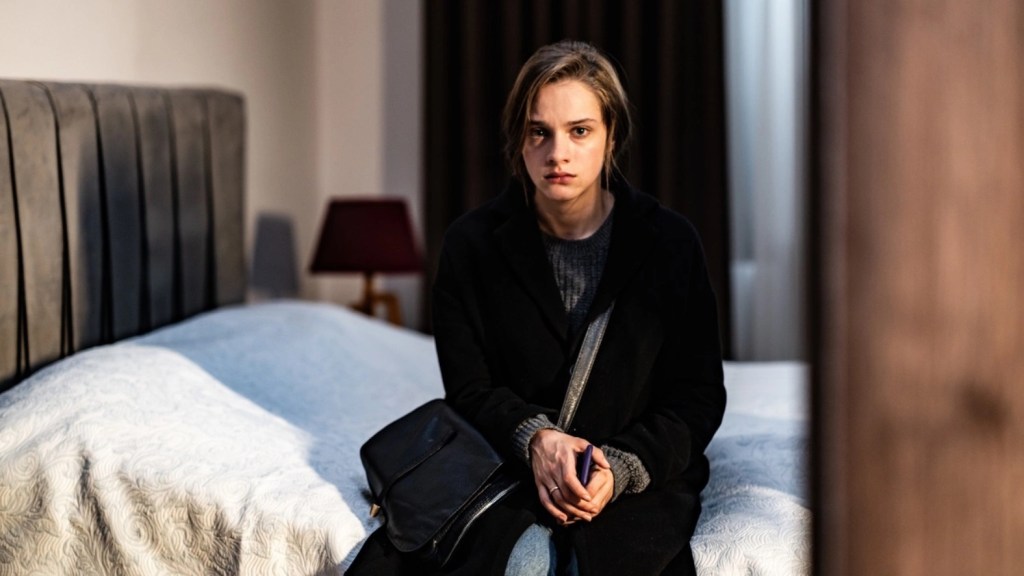
Zeki Demirkubuz · Miray Daner, Burak Dakak, Cem Davran · PG-13 · 3h 13m · 2023
Note: The article contains spoilers about the movie.
Life is the film that heralds the return to the silver screen of Zeki Demirkubuz, who last directed the film Ember in 2016, after 7 years. Additionally, with its 193-minute duration, it is the longest film by the director.
The film fundamentally tells the story of a young woman named Hicran (Miray Daner), who refuses to accept the life imposed on her and runs away from home. When forced to get engaged due to her father’s insistence, Hicran sees escape as her only solution. Rıza (Burak Dakak), who believes that Hicran never wanted to marry him in the first place, initially doesn’t take her disappearance seriously. However, as time passes, the fact that Hicran left him begins to bother him, and he decides to find her and confront her. Rıza travels to Istanbul to find his fiancée, whom he has only seen once, and the events unfold.
The film, although witnessing many characters and their stories, presents a situation of inescapable circumstances in the lives of Hicran, Rıza, and their families. However, in contrast to Demirkubuz’s previous films, we see that the characters in “Life” try to break their ill fate. In this aspect, the film can be said to differ from other films in the director’s filmography. “Life” can be considered as the closest film to “Innocence” and “Destiny” in terms of theme, marking a return to the director’s roots, portraying Rıza, who becomes hopelessly in love with Hicran, a woman he first saw in a photograph, saw closely only twice, and never spoke to, to the point of being willing to do anything for her. It is also possible to draw parallels between the situations experienced by the main characters in the director’s “Tales of Darkness” trilogy, specifically in “Fate” and “Confession,” and the situation of Hicran in “Life.”
It would be accurate to say that the film consists of two parts. The first half focuses on Rıza’s story and his journey to find Hicran, while the second half is centered on Hicran’s story.
Rıza works in a bakery in Sinop-Boyabat with his grandfather Burhan (Osman Alkaş) and uncle. We understand that Rıza, who lost his parents when he was young, has a good relationship with his grandfather. The disappearance of his fiancée Hicran doesn’t seem to upset him much, as they haven’t spent enough time together to develop an emotional relationship. They hardly talked to each other even at their engagement. However, as time passes and he looks at Hicran’s photo more, he starts to question why she ran away and admits to a friend that being left in this way bothers him. He is determined and plans to find Hicran, who he learns is in Istanbul, by any means necessary.
In the film, the scenes and dialogues where Rıza makes economic and political references vividly depict the crisis experienced by the contemporary Turkish youth. The scene where Rıza shares his troubles with his friend, explaining how difficult it is for him to be abandoned by Hicran, was impactful. The scene where his grandfather comes all the way to Istanbul to persuade Rıza to give up his search for the girl was very realistic. The grandfather’s line, “Is it right to follow someone who doesn’t love you, who doesn’t want you, who withholds their love from you?”, is memorable and highlights the individualism of our times. The scene where Rıza discovers that his friend, whom he thought was studying at university, is actually not attending university and is just spending his father’s money in Istanbul, was unexpected. The friend’s lines, “This is Turkey, my son. Here, everyone believes what they want to believe,” are thought-provoking, emphasizing that truth no longer holds sway and everyone finds their own way. The tension in the scene where Hicran sees Rıza for the first time after a long period is well crafted. Other significant scenes include Orhan talking to Hicran about her dreams and the repetitiveness of life, the reunion of Rıza and Hicran after many years, and the scene towards the end where Hicran cries. These are among the key moments in the film.
The grandfather’s line, “Is it right to follow someone who doesn’t love you, who doesn’t want you, who withholds their love from you?”, is memorable.
The scene where Hicran and Rıza meet in a tea garden after many years is reminiscent of a scene in Ömer Kavur‘s “A Broken Love Story“, where the characters played by Kadir İnanır and Hümeyra meet at a bus station after years, with happiness seemingly passing them by. Rıza confesses that he is the reason for everything that has happened to Hicran; if it weren’t for the forced engagement, none of these events would have occurred, and for this reason, he apologizes to her. Following their meeting, Hicran reflects on their past under a tree that symbolizes life, as if it’s a film reel running through her mind, deeply moved by Rıza’s words. In a single, uninterrupted shot, Hicran breaks down in tears. Throughout the film, nothing has affected Hicran as much as what Rıza said to her. She realizes that for years, someone has loved her, for the first time in her life, she understands the harm a man has caused her, and she sees a positive change in herself. This realization is the primary reason for her tears.
It’s possible to say that with its choice of ending, “Life” significantly diverges from the director’s previous films, making it surprising and unexpected. The revelation that Hicran had a dream also blurs the situations a bit and prompts the audience to think.
Regarding the performances in the film, Miray Daner, in particular, excellently portrays Hicran’s constant search for a way out and her sense of entrapment. It is essential to note her success in reflecting the regret and sorrow she feels for running away from Rıza, especially towards the film’s finale. Burak Dakak effectively brings to life the character of Rıza, who, initially indifferent towards his fiancée whom he barely knows, becomes unable to stop thinking about her over time. Osman Alkaş delivers a masterful performance as Rıza’s grandfather, Burhan, with well-written dialogues. Actors like Cem Davran and Umut Kurt also seem to have fulfilled their roles in line with the director’s vision.
It is considered by the director as his best work in terms of cinematography and is the film that most closely aligns with the thematic line of his earlier works “Innocence” and “Destiny.”
It can indeed be said that “Life” is one of the best films of director Zeki Demirkubuz in terms of cinematography. The film’s cinematography is led by the duo Cevahir Şahin and Kürşat Üresin. This duo has previously produced award-winning work in Mustafa Kara’s “Cold of Kalandar” and Nuri Bilge Ceylan‘s “About Dry Grasses“. To be specific, scenes highlighting Rıza’s loneliness amidst the crowds in Istanbul while searching for Hicran, the car scene where Rıza shares his troubles with his friend in Boyabat, and the single-shot scene of Hicran crying towards the end of the film are just a few examples demonstrating the outstanding work of the cinematographers.
In the film, the director employs several metaphors and references. There are two dream sequences that seem to mirror each other. In the first, Rıza opens the door of his house and sees Hicran. He invites her in, and Hicran asks Rıza for water. Overwhelmed by seeing Hicran, Rıza struggles to find a glass in the kitchen. When he finally does, he pours water from the jug in a frantic manner, causing it to overflow from the glass. Similarly, later in the film, Hicran dreams of Rıza, who asks her for water. Just like Rıza, she struggles to find a glass due to the shock of seeing him in her dream. When she finds one, she also pours water from the jug in a frantic manner, leading to an overflow. The fact that both dream of each other in this way could signify that their paths are destined to cross again.In another scene towards the end, Hicran cries under a tree that seems to symbolize the tree of life. Under this tree, she reflects on her entire life, experiences an emotional release, and cries for a long time. In another scene, when Rıza first sees Hicran in a photograph and finds her very beautiful, it hints at a reference to Metin Erksan‘s “Time to Love“, where the theme of falling in love with a photograph is deeply explored.
“Life,” according to director Zeki Demirkubuz, is a film that lives up to its name, telling the story of Hicran, who initially inspired the title and follows her aspirations. It is considered by the director as his best work in terms of cinematography and is the film that most closely aligns with the thematic line of his earlier works “Innocence” and “Destiny.”
 Auteur Avenue