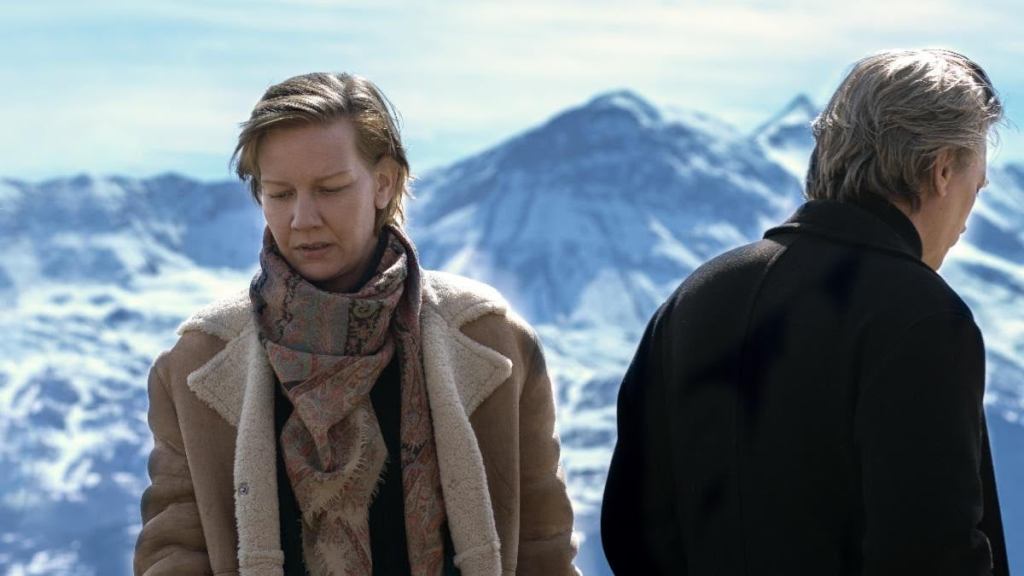
Justine Triet · Sandra Hüller, Swann Arlaud, Milo Machado Graner · R · 2h 31m · 2023
Note: The article contains spoilers about the movie.
The 76th Cannes Film Festival, held this year, saw “Anatomy of a Fall” clinch the top prize, the “Palme d’Or,” marking the latest film by director Justine Triet. The film could be categorized within the crime drama genre, and more specifically, could also be described as a courtroom drama.
In the movie, a writer couple, Sandra (Sandra Hüller) and her husband Samuel (Samuel Theis) live in a mountain house in the French Alps with their 11-year-old blind son, Daniel (Milo Machado Graner). In the opening scene, we see Sandra attempting to give an interview with a journalist, but the rising volume of music, which we soon learn is being turned up by Samuel, whom we have not yet seen in the frame, hints at the tension between Sandra and Samuel. The sequence of events continues as the interview is not completed and the journalist leaves the house; meanwhile, Daniel, returning home from a walk with his dog, finds his father in a pool of blood, dead.
This scene naturally raises the following questions: Did Samuel fall from the attic of the mountain house? Did he jump to his death, or was he pushed by someone else? Since Daniel was outside when the incident occurred, Sandra will be the only suspect tried for Samuel’s death, and the situation will become complicated. Throughout the autopsy and court proceedings, every possibility regarding Samuel’s fall is simulated and analyzed, with the visualization of these scenarios being skillfully laid out in a cinematic fashion. Speaking of autopsies, while the audience expects a clarification of the death, the director cunningly takes a turn and begins to dissect the autopsy of Sandra and Samuel’s troubled marriage, revealing its true nature.
We learn that Daniel’s vision loss is not congenital, but the result of an accident due to Samuel’s negligence. Samuel’s role in this incident and his subsequent feelings of guilt become apparent as the reason he cannot forgive himself. Sandra, on the other hand, blames her husband for the accident, which creates the first rift in their marriage.
It can be said that the movie has a masterfully crafted narrative structure. In court, as we listen to an audio recording from Samuel’s flash drive, we understand and see that Samuel had a violent argument with Sandra before he died. They had intense disputes over financial situations, differing approaches to parenting, their unsatisfying sexual life, and issues of fidelity and infidelity. Sandra throws Samuel’s face into the constant sacrifices she has made, while Samuel confronts her with her extreme selfishness and need for control. At the end of the recording, we realize that the verbal altercation has turned into physical violence, with Sandra attacking Samuel. Furthermore, through the testimony of a therapist in court, we learn that Samuel had attempted suicide before his death and had become depressed.
The courtroom scene, set in the vise of the prosecutor-lawyer-judge triad, where the camera focuses on Daniel but moves towards the speaking person, is just one of the splendid marks made by the director. In court, Daniel, serving as a witness in a case that has become complex, learns that his father had previously attempted suicide and had vomited the aspirin he had taken. He then recalls how one night their dog fell ill and they went to the vet the following morning; during the ride, his father told him not to get too attached to the dog and engaged in a generally depressive conversation. Following this memory, Daniel gives his dog a box of aspirin and re-enacts that night as an experiment, and when the dog exhibits the same symptoms, he realizes his father must have poisoned himself with aspirin. He shares this revelation in court, stating that he cannot imagine his mother killing his father and that he believes his father committed suicide based on his experiment. As a result of all the testimonies and lack of sufficient evidence, Sandra is acquitted, but her acquittal does not definitively prove that Samuel committed suicide. At this point, two questions arise: Could Daniel, having lost his father, have concocted such a story to avoid losing his mother as well? Even if Samuel did commit suicide, could Sandra’s attitude, behavior, and statements have left deep marks on him and influenced his decision to take his life? Triet intentionally leaves these questions unanswered in the viewer’s mind at the end of the movie.
It is an indisputable fact that Sandra Hüller has delivered one of the most impressive acting performances in recent years. She perfectly embodies a character that is emotionally rich and thought-provoking for the audience.
It is evident throughout the movie how much emphasis Triet places on actor direction. The fact that Sandra Hüller was nominated for the “Best Actress” award at the 76th Cannes Film Festival for her performance in Nuri Bilge Ceylan‘s latest movie “About Dry Grasses,” alongside Merve Dizdar, attests to what is undeniably one of the most impressive acting performances in recent years. She perfectly embodies a character that is emotionally rich and thought-provoking for the audience. The performance of Milo Machado Graner, who plays Sandra and Samuel’s son Daniel, also stands out, while the rest of the cast manages to bring their characters to life convincingly within their respective screen times.
“Anatomy of a Fall” is a movie by a director who knows exactly where to place the camera and how to time emotional transitions, in short, a director who has a firm grasp of all elements. With its engaging structure, character developments, and psychological analyses, it is a movie that deserves to be watched attentively.
 Auteur Avenue