
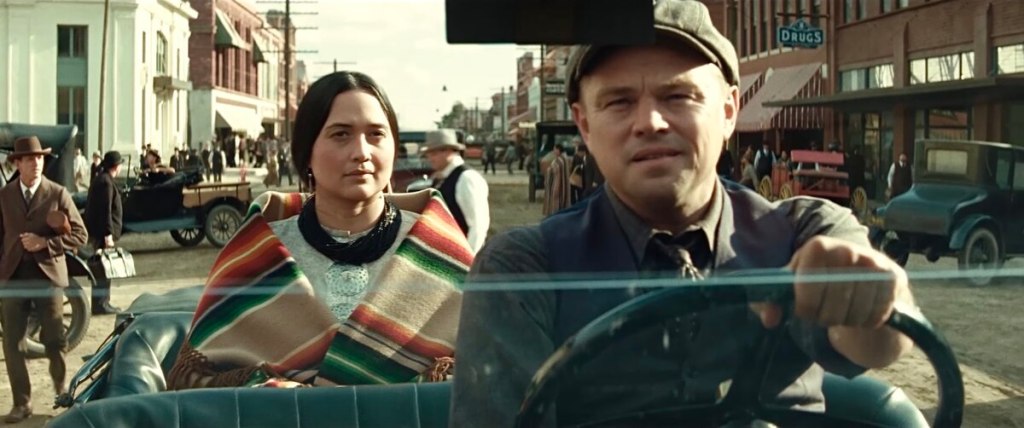
Martin Scorsese · Leonardo DiCaprio, Robert De Niro, Lily Gladstone · PG-16 · 3h 26m · 2023
Finally, director Martin Scorsese, who previously worked on “The Irishman” for Netflix, has now presented his latest movie “Killers of the Flower Moon” for Apple TV. The movie tells the story of America’s first major crime, the horrifying assimilation of the Osage tribe. At one point, the film also touches upon the founding of the FBI and can be seen as a reflection of the dirty exploitation systems of the powerful over the weak. The screenplay for the movie, adapted from David Grann’s 2017 book of the same name, was co-written by the master screenwriter Eric Roth, known for his work on movies like “Forrest Gump,” “Munich,” “The Curious Case of Benjamin Button,” and “Dune,” along with Scorsese.
In the movie, which is based on a true and profound story, we occasionally hear the voice of a narrator who, in a way, offers a few sentences explaining why the movie is called “Killers of the Flower Moon”: “In May, when the jackals howl under the full moon, long plants like telegraph flowers and sun hats begin to lean over smaller flowers, stealing their light and water. The necks of the small flowers break, their leaves scatter, and before long, they are buried underground. That’s why the Osage Indians call May the time of the Flower Moon.”
The movie is set in the early 1920s in the Osage region of Oklahoma. America had left some of the land it deemed barren to certain Native American tribes, including the Osage, and had not interfered with their territories. However, when oil is discovered in the land they had overlooked, the situation takes a different turn. At the beginning of the movie, we see an iconic scene reminiscent of Paul Thomas Anderson‘s “There Will Be Blood,” where Native Americans dance with the oil spurting from the ground. However, the dancing Native Americans are unaware of the hardships that await them. The movie gradually depicts how the Osage families intermarry with white newcomers, how they lose their land, property, and money through mysterious deaths of women and various conspiracies.
Right at this point, we meet William Hale (Robert De Niro). He is a man who befriends the Osage tribe and marries his relatives and men to the women of the tribe. Hale is a man of ambition but not particularly brilliant. His nephew, Ernest (Leonardo DiCaprio), a World War I veteran, is also unaware of the complexity of the situation he is about to get into and is the final piece in Hale’s plan regarding the Osage tribe. As part of Hale’s scheme, Ernest needs to woo Mollie (Lily Gladstone), a wealthy woman from the Osage tribe, and gradually acquire her wealth.
It’s impossible to ignore the level of passion for cinema that the director, despite being 80 years old, brings to every scene of the movie.
Martin Scorsese bringing together Leonardo DiCaprio and Robert De Niro, both of whom he has worked with multiple times in different movies, for the first time in the same movie undoubtedly elevates the viewing experience to a higher level. DiCaprio, who consistently sets a high standard in acting, is joined by De Niro, who shares almost the same amount of screen time, and delivers a highly minimal yet effective performance. Some actors elevate the movies they are in, and some movies elevate the actors. In the case of Lily Gladstone, who portrays Mollie, it can be said that both situations are true. She proves every second that she is an incredibly fitting choice for the character she portrays, and it’s undeniable that she’s an excellent actress who can convey so much even with just her eyes in scenes without dialogue. It’s possible to say that Gladstone delivers the most striking performance in the movie.
It’s impossible to ignore the level of passion for cinema that the director, despite being 80 years old, brings to every scene of the movie. “Killers of the Flower Moon” is a movie that doesn’t shy away from shedding light on the dark side of 1920s America, where boundless ambition and corruption are deemed permissible.

