Tom Ford · Amy Adams, Jake Gyllenhaal, Michael Shannon, Aaron Taylor-Johnson · R · 1h 56m
Tom Ford, better known for his work in the fashion industry, takes a bold step into the world of cinema with “Nocturnal Animals”. From the very first frame, it becomes clear that Ford’s meticulous attention to detail and aesthetics knows no bounds. His ability to combine his fashion sensibilities with the requirements of cinematic storytelling is the first detail that catches the eye.
The film’s cinematography, directed by renowned cinematographer Seamus McGarvey, is breathtaking. Ford’s keen eye for design and aesthetics permeates every frame, and every shot is a meticulously crafted painting. The contrast between Susan’s austere, sterile and soulless Los Angeles life and the hauntingly visceral world of the novel comes vividly to life.
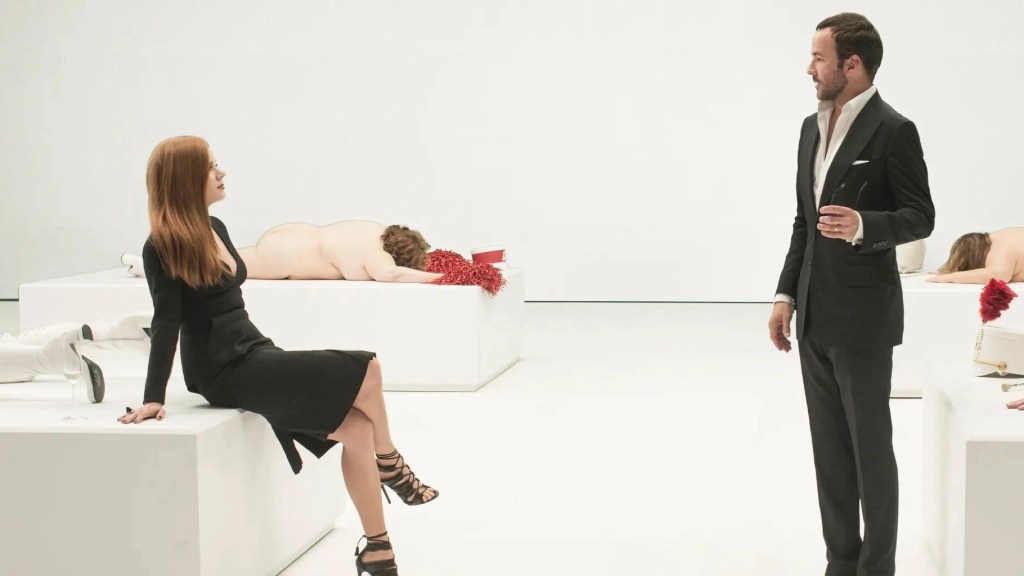
One of the most striking aspects of “Nocturnal Animals” is the way Ford uses symbolism and visual motifs to convey emotional depth. For example, in the opening credits, a series of overweight and elderly women dancing naked with red, white and blue banners evoke a sense of social standards, decadence and fragility. This sets the tone of the film and offers a glimpse into Ford’s ability to convey meaning and emotion through visuals.
The use of colour is another powerful tool in the film’s arsenal. The sharp contrast between the cold, sterile tones of Susan’s world and the warm, desaturated hues of Edward’s novel intensifies the emotional experience. The desert scenes in the novel’s narrative are particularly striking; the vast, arid landscapes are bathed in a haunting orange glow, emphasising the desolation and emptiness lurking in the hearts of the characters.
At its core, “Nocturnal Animals” is a gripping and effective revenge story. The narrative is sensitively constructed to explore themes such as revenge, redemption and the consequences of one’s actions. It is a story of revenge that stands out for very compelling reasons.
Firstly, revenge in “Nocturnal Animals” is not a simple, one-dimensional quest for justice. Instead, it is a layered and morally ambiguous manifestation of the desire for revenge. Edward’s novel serves as a vehicle for Susan to express her pain and anger, but it also forces her to confront her own actions and their effects. The revenge in the film is both a punishment and a reckoning.
Edward’s novel serves as a vehicle for Susan to express her pain and anger, but it also forces her to confront her own actions and their effects. The revenge in the film is both a punishment and a reckoning.
The power of the revenge narrative lies in its ability to keep the audience interested and emotionally invested. As events unfold in the novel, the viewer is torn between empathising with Tony’s quest for justice and increasingly understanding Susan’s past actions. This moral ambiguity makes the revenge story all the more compelling as it forces the viewer to grapple with complex questions of guilt and responsibility.
Moreover, the conclusion of the film adds another depth to the revenge narrative. Without giving spoilers, we can say that the conclusion is both poignant and thought-provoking, leaving the audience with a lasting sense of unease and introspection. A conclusion that beautifully summarises the film’s themes of regret, loss and the cyclical nature of revenge.
All in all, “Nocturnal Animals” is a cinematic achievement that combines stunning cinematography with a directorial finesse that perfectly conveys emotional intensity and tension. Tom Ford proves to be a visionary director with an uncanny ability to blend fashion sensibility with cinematic storytelling.
 Auteur Avenue