
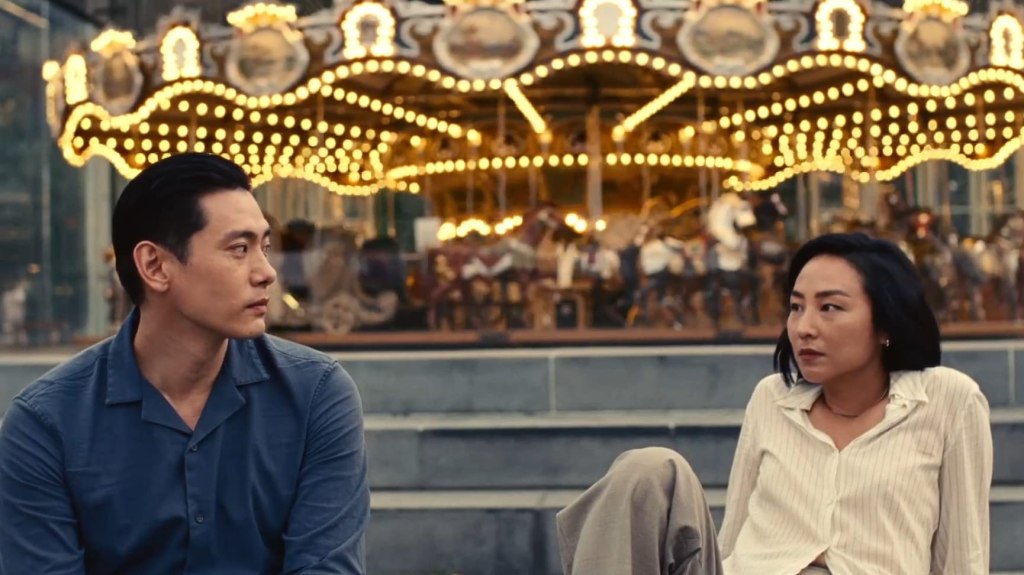
Celine Song · Greta Lee, Teo Yoo, John Magaro · PG-13 · 1h 45m
“Past Lives” is a film that adopts a deliberate and measured approach to storytelling, culminating in a thoughtful exploration of love and identity. The film values simplicity and a natural narrative flow, and stands out with its ability to convey a clear story while combining symbolic elements through the clever use of camera angles. In a cinematic landscape where films such as “Everything, Everywhere, All at Once”, “Decision to Leave”, “Burning”, “Parasite” and “Drive My Car”, all Far Eastern productions that have achieved great success in recent years, have made waves with their intricate narratives, “Past Lives” carves out a unique place for itself by offering a simpler and yet emotionally resonant experience.
The film is distinguished by its incorporation of symbolic narrative elements through the strategic use of camera angles. These angles skilfully anticipate the characters’ future paths and enrich the storytelling with additional layers of meaning. There is a striking visual metaphor in the final scene of the first episode, where Nora ascends a steep staircase while Hae Sung follows a simple path. This stark contrast symbolizes their different life journeys and sets the tone for the narrative to come. These symbolic moments, though not subtle, provide valuable insight into the characters’ evolving identities and destinies. In the film’s closing sequence, as the camera moves continuously to the left along a linear plane, Nora and Hae’s wordless stroll down memory lane and heartfelt goodbyes are particularly moving. This is followed by a poignant moment in which Nora steps backward along the same path, but this time in solitude. In this powerful scene, Nora effectively conveys to the audience a deep sense of nostalgia and the weight of missed opportunities.
The director’s unwavering commitment to delivering a straightforward and unpretentious narrative in “Past Lives” yields significant dividends. This deliberate approach results in a story that maintains remarkable clarity and accessibility from start to finish, creating an environment in which the audience can genuinely engage with the characters and immerse themselves in their transformative journey. By eschewing convoluted plot twists and heavy-handed storytelling techniques, the director allows the essence of the narrative to shine through. This simplicity in narrative style allows for a more profound connection between the audience and the characters, as there are no distracting layers or unnecessary complexity to hinder the emotional resonance of the film.
It’s a journey of self-discovery and the enduring power of love’s memory.
And what is “Past Lives” about, you may ask? Without giving away too much, it’s a tale that spans continents and lifetimes, a story of love lost and found, of childhood crushes and changing identities. It’s a narrative that explores the profound connections between people, connections that transcend time and place. It’s a journey of self-discovery and the enduring power of love’s memory.
In conclusion, “Past Lives” is a film that takes a conscious and thought-provoking approach to exploring issues of love and identity. The film’s clear storytelling, coupled with the effective use of camera angles and symbolism, provides viewers with a thought-provoking and emotionally resonant experience. “Past Lives” may not aim to dazzle with its complexity, but it manages to leave a lasting impression with its sincere and heartfelt storytelling.
 Auteur Avenue