
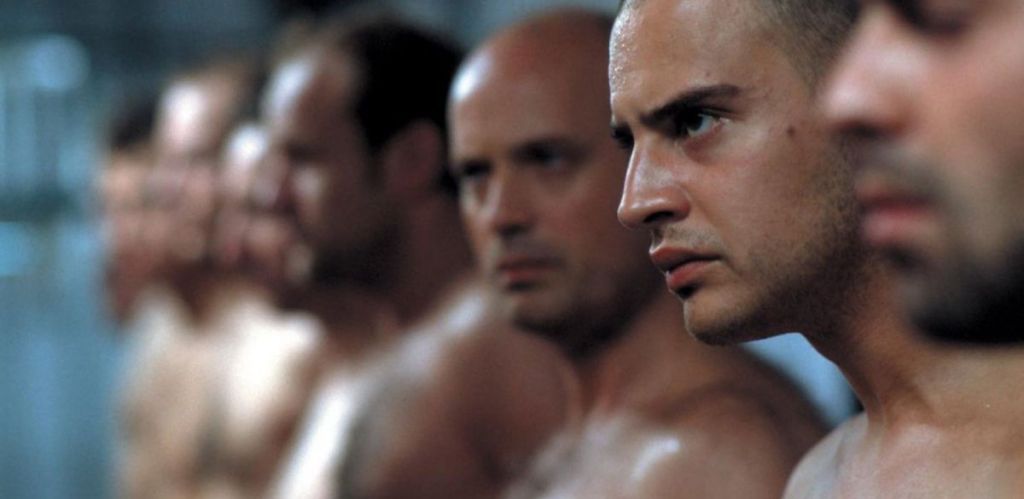
Oliver Hirschbiegel · Moritz Bleibtreu, Christian Berkel, Oliver Stokowski · R · 2h · 2010
Directed by Oliver Hirschbiegel, “The Experiment” (original title: Das Experiment) is a psychological thriller movie that incorporates elements of drama and crime. The film stars Moritz Bleibtreu, whom we know from Fatih Akın’s movies “In July” and “Soul Kitchen.”
The movie draws inspiration from the Stanford prison experiment, a social psychology experiment conducted in 1971 with the participation of 24 students, which aimed to explore the psychology of being a prisoner and a guard. “The Experiment” is also adapted from Mario Giordano’s novel “Black Box.”
In the movie, scientists design an experiment to measure people’s instinctual impulses. A total of twenty male volunteers are placed in a fictional prison setting, where their psychological and physical conditions are tested. The changes experienced by the participants during this process are observed.
Prior to the experiment, participants are assured of their safety, informed that they will not face violence or harm, and that they will only be deprived of certain citizenship rights. Participants are divided into 6 guards and 20 prisoners. Guards are given rules and are informed that the experiment will be terminated if they do not adhere to these rules. What follows is of a nature that shakes the perception of reality. Rule-breakers must be punished, and this punishment can extend beyond physical violence. This situation leads to the emergence of previously unexpressed egos of the guards and their engagement in criminal behavior.
Among the themes the movie focuses on are the influence of power on human behavior, and the transformations of characters under intense stress and pressure. The movie effectively conveys to the audience the psychological foundations of brutality in a realistic manner. It depicts how the unchecked use of power affects individuals and how people can abuse this power. Additionally, it observes how personalities change under pressure and how these changes influence behavioral patterns.
“The Experiment” is considered an important movie from psychological and sociological perspectives. The movie’s core revolves around the perspective that even the weakest individuals can transform when given appropriate conditions.
As depicted in the movie, when people are given too much power, it is evident that both the weak and the powerful can abuse that power. This experiment concretely illustrates the saying, “Uncontrolled power is not real power.” Unlike the real experiment, the one in the movie is prolonged, leading individuals to experience fatal consequences and serious psychological effects.
The pleasure of wielding uncontrolled power leads to a conflict between the two groups and a difficulty in establishing empathy. The movie portrays how the oppressed and oppressors undergo changes under intense stress, and how an artificial power can encourage ruthless actions.
The pleasure of wielding uncontrolled power leads to a conflict between the two groups and a difficulty in establishing empathy. The movie portrays how the oppressed and oppressors undergo changes under intense stress, and how an artificial power can encourage ruthless actions.
The performances in the movie are also quite impressive. It’s evident that Moritz Bleibtreu, in the lead role, delivers a compelling performance.
“The Experiment” is a movie that vividly demonstrates how communities and assigned roles can alter individuals’ behaviors. The quick adaptation of the participants into the roles of guards and prisoners emphasizes the power of social psychology and interaction.
 Auteur Avenue