
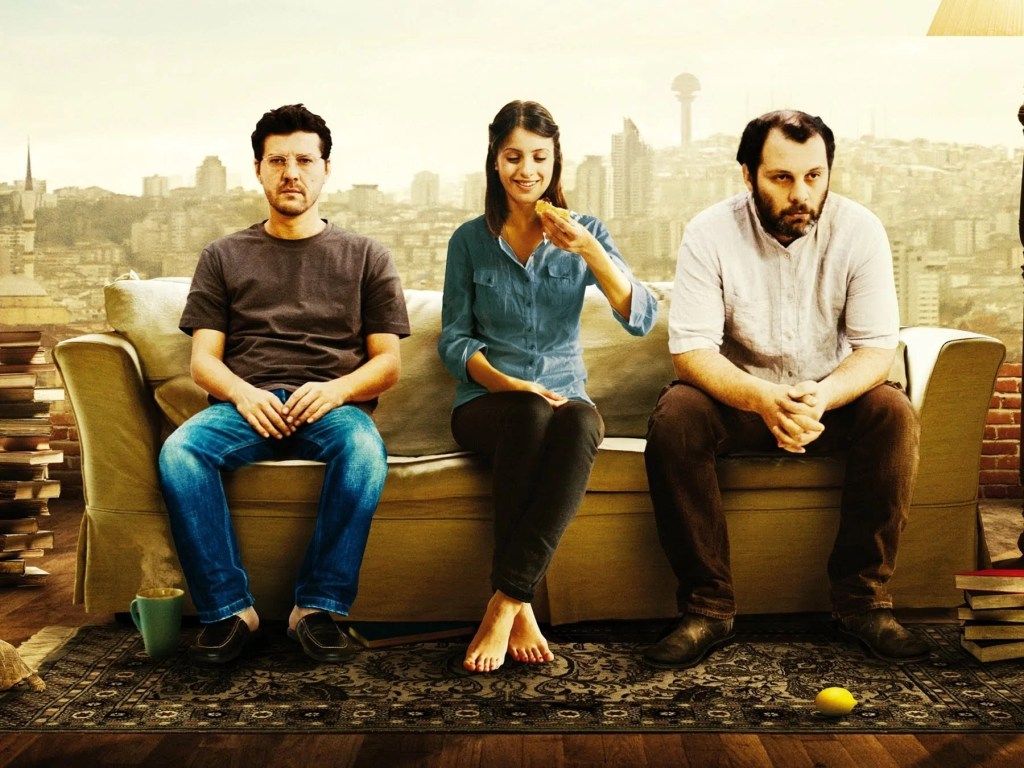
Seyfi Teoman · İlker Aksum, Fatih Al, Güneş Sayın · 1h 42m · 2011
“Our Grand Despair” is the final feature film directed by Seyfi Teoman, who passed away at a young age. Released in 2011, the movie is an adaptation of the novel of the same name by Barış Bıçakçı. The involvement of the novel’s author in the screenplay writing process undoubtedly contributes to the successful adaptation of the story.
The movie primarily revolves around a slice of life from the childhood friendship of Ender (İlker Aksum) and Çetin (Fatih Al), who have been living together in the same house. Their close friend Fikret (Baki Davrak) miraculously survives a car accident but tragically loses his parents. While Fikret needs to return abroad for work, he has a “problem” to solve: his younger sister Nihal (Güneş Sayın), who is now left alone. She is a student at Ankara University with two years left until graduation. Fikret entrusts his sister to his closest friends, Ender and Çetin.
Ender and Çetin’s accustomed life as a duo has now become a trio. Due to the trauma she experienced, Nihal doesn’t want to communicate with Ender and Çetin. Initially, they feel a sense of responsibility as “father figures,” but over time, things take a different turn, and an unnamed closeness emerges between them.
After Nihal goes to her brother Fikret’s place for vacation, Ender and Çetin also go on a holiday. When the receptionist at the hotel they visit for vacation remarks that both of them look pale, it signifies an important change in their lives. Nihal has become a color and an indispensable part of their lives. When they sit down and start talking about Nihal, the same sentence comes out of their mouths: “I’m in love with Nihal.” Initially, this scene may not seem very realistic, but it is so well-written, directed, and acted that it’s impossible not to believe it. Ender also later admits that they had always harbored the same dream of falling in love with the same girl since childhood.
A movie remains in our minds with certain moments and scenes, and “Our Grand Despair” can be considered a rich film in this regard. For instance, the scene where Çetin’s brother Murat (Taner Birsel) delivers a speech at the dinner table is memorable. Like Fikret and Nihal, Çetin and Murat have also lost their parents in a traffic accident, and Murat has served as both an older brother and a father figure to Çetin. When he mentions that there is something that never passes, something solid and unchanging, while contemplating whether everything could have been different, it leaves a significant impact on the audience. Similarly, when Ender confesses that he hasn’t read some of the books in Nihal’s library, Nihal asking Ender to write a poem for her, their attempt to walk with their eyes closed, their conversation about jam on top of cheese at the breakfast table—these moments and scenes can be cited as examples.
Ender and Çetin’s relationship is also unique. They complement each other very well and, despite occasional disagreements, they have never been able to let go of each other since their childhood.
At the end of the movie, Nihal has graduated, grown up, and will return to her brother’s side. The last note she leaves for Ender and Çetin reads: “To the world’s best two people…” In fact, the movie portrays Ender and Çetin’s efforts to avoid growing up, as well as Nihal’s inevitable journey into adulthood.
Being an adaptation of a novel by Barış Bıçakçı, the movie is set in Ankara and successfully integrates iconic locations such as Kuğulu Park, Gençlik Parkı, and Anıtkabir. “Our Grand Despair” takes its place among the good literary adaptations in Turkish cinema, offering memorable scenes to the audience.
 Auteur Avenue