Darren Aronofsky · Hugh Jackman, Rachel Weisz, Ellen Burstyn · R · 1h 37m · 2006
Director Darren Aronofsky’s first movie after Requiem for a Dream, The Fountain, can be described as an epic romantic drama movie. In addition, it is a movie in which the director skillfully synthesizes historical, spiritual, and science fiction elements.
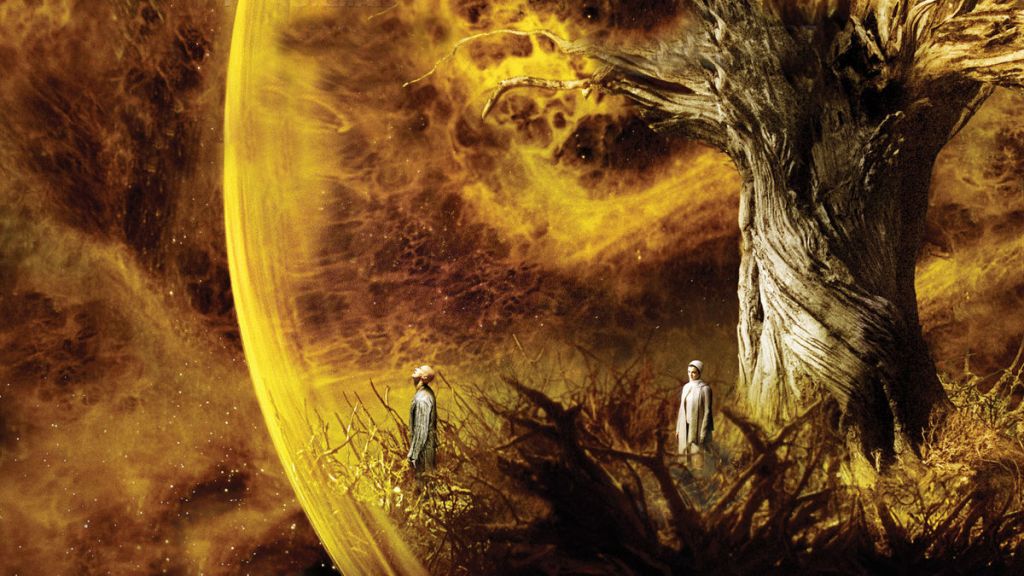
In 16th century Spain, where the Inquisition courts continued to exist, a conquistador named Tomas Verde (a military title given to soldiers who bring the lands under Spanish sovereignty and also meaning “conqueror”), receives an order from Queen Isabella to liberate Spain from slavery and find the tree of life. After that, we are transported to the present day while Tomas is passing through some ordeal, and we see another version of the same character. That character’s name is Tom. Tom is a neurobiologist who is dedicated to saving his beloved wife, Izzi, from the clutches of death after she is diagnosed with a brain tumor and is conducting some experiments. This is actually a journey in which Tom understands the meaning of life, love, and death. During this journey, we see another version of the character. His name is Tommy, and he is traveling in a bubble that contains the tree of life to the nebula named Xibalba, which is said to explode in Maya beliefs, in the deep space of the 26th century. His goal here is to deliver the tree of life to Xibalba. This tree is also the tree of wisdom, and as one eats a part of the tree, it reinforces their immortality. As Tommy continues his journey here, we also hear Izzi saying “finish it.” with Tommy. Tommy also says, “I don’t know how to finish it.” Then we return to the events of the present day and understand that Izzi said this sentence to Tom. Izzi is also a novelist and a character who is about to complete her book. However, when she realizes that her life won’t last, she leaves the task of writing the final of the book to her husband, Tom. Although Tom has succeeded in his dedicated experiments, he has lost his beloved wife, Izzi, despite all his efforts to cure her.
We understand through the repeating scenes, different timelines, and the interweaving of spaces that Tomas in the 16th century and Tommy in the 26th century we saw throughout the movie are fictional versions of the Tom in real life. While Tom reads the book, we dive into these fictional worlds with him. Ultimately, we see that Tom has realized that he is a soulmate to these characters, internalized them and thus, managed to write the end of the book. He wrote a bad ending for the past character but a good ending for the future character. At the end of the movie, and therefore the book, Tomas finally reaches the tree of life as a result of the order given by his queen. When he applies the essence of the tree to his wound, he heals, but cannot resist his greed and pays the “price of his sin” after he consumes its essence. Flowers bloom from his wound, and his body integrates with the world. All three of Tomas, Tom, and Tommy need to make sacrifices to achieve their goals. This means giving up earthly reality. The ring in Tomas’s hand reaches Tommy, his future version, and he also achieves his main goal, reaching Xibalba, and the tree reappears.
The movie was unsuccessful at the box office when it was released, but it has gradually become a cult movie whose value has been increasingly recognized over the years. According to some film critics, the Fountain is considered Aronofsky’s masterpiece. Although the movie is not an adaptation and has an original screenplay, it gives the audience the feeling of having read a long poem or novel when it ends. The movie has a non-linear structure, with a narrative that interweaves the same characters in different settings. It can be said that the visual choices made in lighting and composition are very effective in immersing the viewer in different worlds. The movie’s visual effects were achieved by recording chemical reactions of materials used in photography, rather than using CGI.
The movie’s production process was quite tumultuous. Aronofsky was influenced by The Matrix and wanted to make a profound science fiction movie. The filming lasted for 6 years. In addition to budgetary problems, the initial version of the movie had completed pre-production, and Brad Pitt and Cate Blanchett were supposed to play the two lead roles. When the movie was about to start shooting, Pitt withdrew at his own request and Blanchett asked to be excused from the movie because she was pregnant.
It is impossible not to feel the impact of Hugh Jackman’s dramatic acting throughout the movie, such as in the scene where he tattoos a ring on his finger with the tip of a fountain pen and walks outside in the silence of death after realizing that Izzi’s illness is worsening. Rachel Weisz displays her skills in the role of Izzi, and although Ellen Burstyn’s role in Fountain is more complementary than her role in Requiem for a Dream, she also does her part.
It is also impossible not to take one’s hat off to Clint Mansell’s soundtrack, which is integrated with the story throughout the movie, especially “Death is the Road to Awe.” The partnership between Aronofsky and Mansell, which garnered more attention in Requiem for a Dream like the partnership between Christopher Nolan and Hans Zimmer, elevates the movie to another dimension.
The Fountain is a multi-layered movie that deserves to be watched multiple times, and it also offers philosophical insights with its religious and mythological subtexts. To summarize the movie with a lyric, as Sezen Aksu said, “Dreams and realities live separately.”
 Auteur Avenue