Ruben Östlund · Harris Dickinson, Charlbi Dean, Dolly de Leon, Woody Harrelson · R · 2h 27m
Ruben Östlund, who won the Palme d’Or at the Cannes Film Festival in 2017 with his film “The Square,” returned to the big screen five years later with “Triangle of Sadness,” which is also in the genre of dark comedy. The film earned the director his second Palme d’Or at the Cannes Film Festival last year.
The director has divided the film into three parts and has criticized capitalism from different angles in each part. The film follows the relationship between Carl, who is trying to make a living as a model, and Yaya, a social media influencer.
The first part, “Carl and Yaya,” features their argument over the bill in a fancy restaurant, which plays an important role in the film. The argument leads viewers to reflect on issues such as trust and gender roles in society. It could be argued that the argument is too long and even stretched out like chewing gum, but it is clear that this is a deliberate choice by the director.
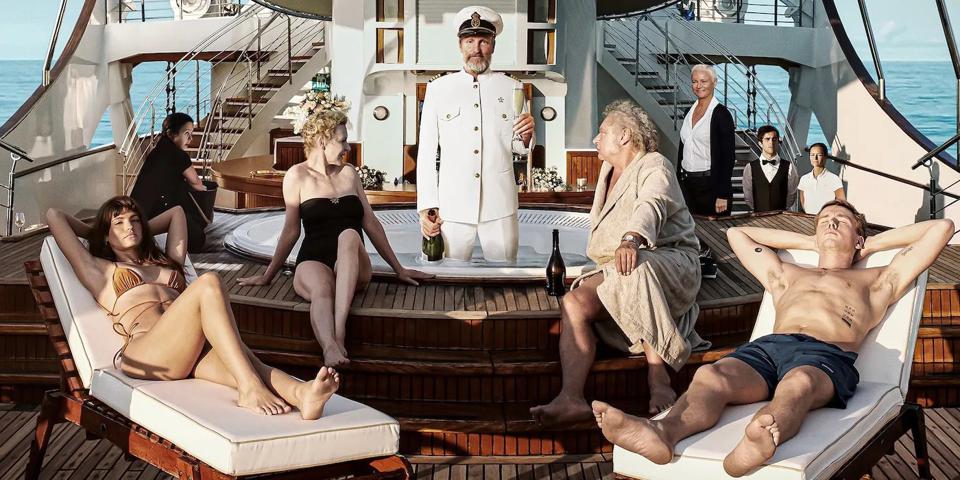
The second part of the film, “The Yacht,” depicts how the bourgeois upper class sinks into a quagmire while having fun on a cruise ship. In this part, the focus of the film shifts from Carl and Yaya to the bourgeoisie. Yaya and Carl participate in this trip for free as part of an advertising deal, and viewers have the opportunity to observe the aristocratic and hyper-rich classes along with them. We see many people on the same ship, such as a woman who forces a worker to jump into the pool, a weapon dealer who complains about his declining profits after the UN regulation on the sale of explosives, a strange Russian oligarch, and an extremely wealthy but insecure software developer. This part highlights how everyone is on the same ship in the capitalist world. During the captain’s dinner scene, the alcoholic and communist captain Thomas (Woody Harrelson) and the Russian oligarch exchange words from Marx, Lenin, Thatcher, and Kennedy. As the storm approaches, the ship narrowly avoids capsizing, and the bourgeois class reverts from their most sterile to their most primitive state.
The third and final part of the film, “The Island,” portrays how the hierarchy is overturned and people are struggling to survive in a tangled web of upside-down relationships after a luxury yacht sinks. In a situation where resources are limited, an Asian cleaning lady rises to the top of the hierarchy by using her skills among those who only know how to survive with money. However, it can be said that the social criticism in this part becomes a bit didactic, and the parody’s dose goes too far.
In general, if we evaluate the film, the personal relationships that begin in the first part evolve into a social and class-based perspective in the second part and take on a political meaning. In the third and final part, in a world where everything is upside down and the parody’s dose is excessive, the film loses some of its impact and striking power. Nevertheless, “Triangle of Sadness” can be considered a film that does not neglect to say things that are highly relevant to today’s capitalist system.
 Auteur Avenue