
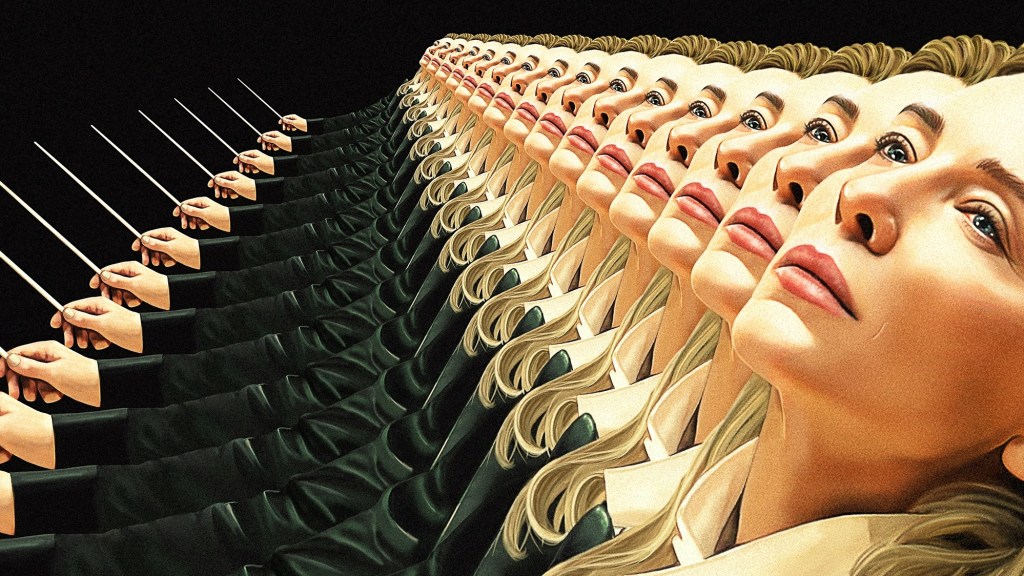
Todd Field · Cate Blanchett, Noémie Merlant, Nina Hoss · R · 2h 38m
Todd Field’s new film “Tár” follows the life of Lydia Tár, a celebrated conductor and composer, played by Cate Blanchett. Exploring the life of a woman who seemingly has everything, the film also takes viewers into a world of fear and paranoia.
Lydia’s life is introduced to the audience through an interview with Adam Gopnik, played himself, as he interviews her on a Manhattan stage. Lydia’s resume is impressive and filled with glory, and she has been installed at the pinnacle of her profession. However, Lydia’s rise is not what the film focuses on. Instead, viewers are shown her downfall, and Field expertly portrays it with horror elements.
Throughout the film, Field scatters omens and hints in Lydia’s path, making the audience question whether she is the victim or the monster. Lydia’s charisma is overpowering, and her power is unchecked. While Lydia is undoubtedly a tremendous musician, capable of inspiring others to greatness, she is also capable of betrayal and gaslighting, which the film portrays objectively. Field does not compromise on impartiality while observing Lydia’s decline, but he does not spare his compassion either. “Tar” takes place in a rarefied cultural space where aesthetic perfection is a daily expectation, making it a thought-provoking and visually stunning film.
But Lydia’s talent is ultimately overshadowed by her flaws. Field slowly reveals the toxic elements of her personality, which lead to a shocking and tragic finale. As the film progresses, it becomes clear that the protagonist is not just a victim of circumstance but also a perpetrator of terrible deeds. She is a complex, multi-faceted character, as unpredictable and captivating as she is destructive. Blanchett’s flawless performance cannot be overlooked in this irrefutable charisma and persuasiveness of the character on the audience.
In many ways, “Tár” is a study of power and its corrupting influence. Lydia’s ascent to the top of the classical music world has given her a sense of invincibility, and she uses her authority to manipulate and control those around her. Her relationships are fraught with tension and resentment, and she struggles to maintain her grip on the orchestra and her personal life. In this sense, the film can be seen as a commentary on the toxicity of ambition and the dangers of unchecked ego.
Field’s direction is impeccable, capturing the tension and atmosphere of the film with precision. The cinematography, by Florian Hoffmeister, is equally stunning, with stark, minimalist compositions that convey the sense of unease and claustrophobia that pervades the story. The score, composed by Hildur Guðnadóttir, is haunting and beautiful, adding an additional layer of emotional depth to the film.
Overall, “Tár” is a masterful work of cinema that explores complex themes with intelligence and an artistic approach. It is a challenging film, one that grapples with difficult questions about power, morality, and human nature. But it is a deeply rewarding experience, one that lingers long after the final credits have rolled.
In conclusion, “Tár” is a chilling and elegant work of art that immerses the audience in a world of dread and paranoia. Field’s psychological style and Blanchett’s performance make the film a must-watch for anyone interested in a character study of a complex and powerful woman.
 Auteur Avenue