
Alfonso Cuarón · Julianne Moore, Clive Owen, Chiwetel Ejiofor · R · 1h 49m · 2006
In London, in 2027…
Theo Faron (Clive Owen) is an unassuming man living in a pessimistic but realistic world of the future. Terrorism has spread worldwide, and only England has managed to stand firm. As a result, there is a massive influx of refugees from all over the world, both legal and illegal, seeking refuge in England. Infertility is one of the main reasons for these problems, and the youngest person on earth is 18 years old. Theo’s ex-wife Julian (Julianne Moore) crosses paths with Theo in some way. Julian is the head of one of the organizations in the city that appears to be aimed at helping refugees. Theo’s cousin holds an important position in the government, so Julian asks Theo to obtain permission papers to take two refugees to the port city of Bexhill. Theo agrees to do the job for money. Theo, Julian, and the two refugees are unexpectedly attacked as they drive away with the permission papers. Julian dies, and Theo takes the two refugees to the organization’s headquarters. There, he learns that one of the refugees, Kee (Clare-Hope Ashitey), is pregnant. In a world dominated by infertility and chaos, Theo sees this as a miracle and learns that the real purpose is to deliver Kee to a group called the “Human Project.” Theo then overhears a conversation at headquarters and learns that Julian was actually a victim of an internal assassination within the organization. He takes Kee and the other refugee and escapes. They seek refuge at the home of Theo’s friend Jasper (Michael Caine), rest, and receive help for their journey. After they leave Jasper’s house, the organization goes there and kills him. Theo and the two refugees reach the refugee camp in Bexhill. Meanwhile, the birth, or what Theo calls a “miracle,” occurs, and a baby girl is born. They must reach the “Human Project” ship as soon as possible to protect her. The organization arrives in Bexhill, and violent clashes ensue between the army, the organization, and the refugees. After a long chase, Kee and the baby reach the ship, but Theo dies.
In addition to being a science fiction film, the 2006 joint production of the USA and UK, Children of Men, depicts a remarkably realistic world. The film’s script is based on the dystopian work of P.D. James, published in 1992, with the same name. The Mexican Oscar-winning director Alfonso Cuarón, who has made a name for himself in cinema circles with films such as Harry Potter and the Prisoner of Azkaban, Gravity, and Roma, clearly displays his unique cinematic language in this film and manages to keep the audience within his world from the first scene to the last. Considering Cuarón’s success in creating an atmosphere, it should be noted that this success is not coincidental. It can also be said that the film highlights directing and visuals more than the script, and this is a conscious choice. There are also futuristic elements in the film, but it is possible to say that a realistic portrayal of the near future is made along with unobtrusive special effects. Slovak sociologist and writer Slavoj Zizek have also commented on the film: “It reflects reality itself rather than offering an alternative reality.
The film can be summarized as Theo, who has been involved in political actions in the past but has since become apolitical, finding himself in a series of events. In the film, we witness Theo’s psychological transformation as if events are happening around us. The film also portrays the phenomenon of authoritarian regimes, as in George Orwell’s dystopian literature classic 1984. Moreover, sterility is the main cause of chaos here. Dan Brown‘s bestselling novel Inferno (published in Turkish as Cehennem) and the film adaptation of the novel also dealt with sterility. The film presents the helplessness and despair of refugees and criticizes immigration policies with the refugee camps it portrays. There are also religious subtexts in the film, such as Kee becoming pregnant despite the prevailing sterility in the world. This brings to mind the story of Jesus and Mary since Kee is also a virgin like Mary. The birth of the child is seen as a new era. Interestingly, the name of the Human Project’s ship that Kee and her child will board is Tomorrow.
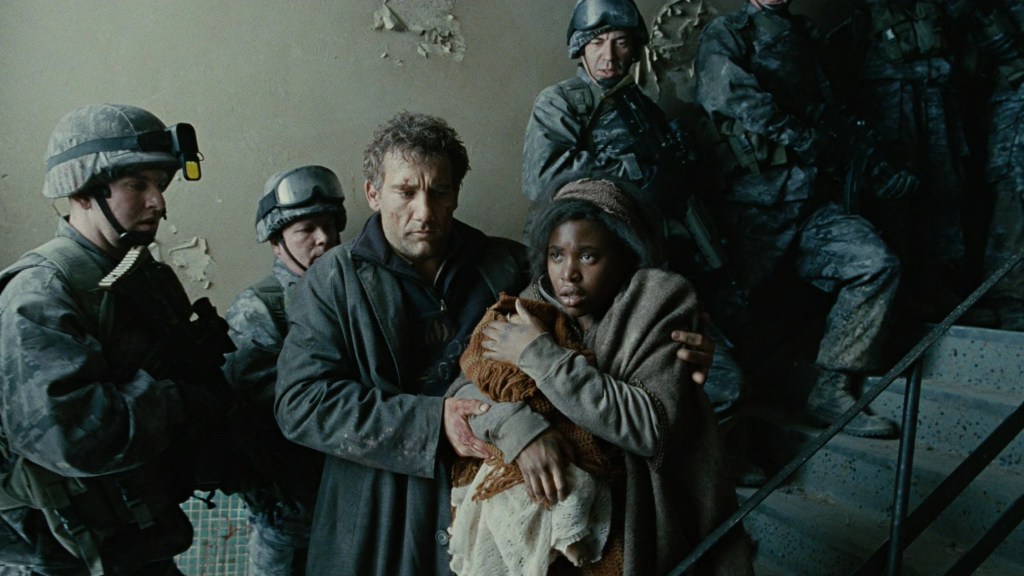
One of the distinctive features of the film is certainly the collaboration between the director and the cinematographer. Emmanuel Lubezki, who previously worked with Cuarón on the film Gravity, for which he won an Oscar, along with such films as Birdman and Revenant, took on the cinematography of the film, which is evident from its well-designed and successfully executed long-take scenes (such as Julian’s death, Theo’s escape from the headquarters, and being caught in the middle of the conflict with Kee), which keep the tension and action at its peak. Moreover, the scene where soldiers witness the “miracle” of Theo, Kee, and the newborn baby in the midst of the conflict in complete silence has become one of the most iconic scenes in cinema history. The film’s ability to immerse the audience in the center of the events, create unease, and convey chaos is also one of its strengths. Additionally, the production design and art direction must also be highlighted. These two departments successfully portrayed the abandoned buildings, the atmosphere of the rescued areas, and the sense of desolation, making a significant contribution to the film’s overall atmosphere.
As we mentioned before, the film basically ends with Kee and her child reaching the ship, which is the manifestation of the underlying religious subtext. However, like a truly independent film, it has an open-ended finale. What will happen to “tomorrow,” the ship itself? Will it be good or bad? Everyone can make their own interpretation. Let’s end with a striking line from the film: “Without the voices of children, the world is a strange place!”
 Auteur Avenue